
Why brand, sales, and customer alignment are the foundation of a product that earns its place.
I've been thinking a lot about what makes a product successful, and how often we look at the product itself as the starting point. We talk about the design, the materials, the fit, the details, and what makes something stand out on a rack or online. But these are only pieces of a much larger picture. Before we can make a great product, we need to understand the forces that shape it.
I recently found myself working through a situation where three people were looking at the same product opportunity, each with a different interpretation of what the business needed. There was a vision for the brand, an expectation for how the product should sell, and an idea of what the customer wanted, but the challenge was that they weren't necessarily working toward the same outcome.
It made me step back and consider how often this happens. We expect product to bridge the gap between brand, sales, and customer, yet we don't always take the time to establish what each of those elements means or how they relate to one another. Without that clarity, product development becomes a series of individual decisions rather than a cohesive strategy.
Insert the infamous triangle to help explain these relationships. Brand, sales, and customer form the foundation, with product sitting at the center. Each side has a distinct responsibility, and the relationships between them determine how well the product serves the business and the people buying it.
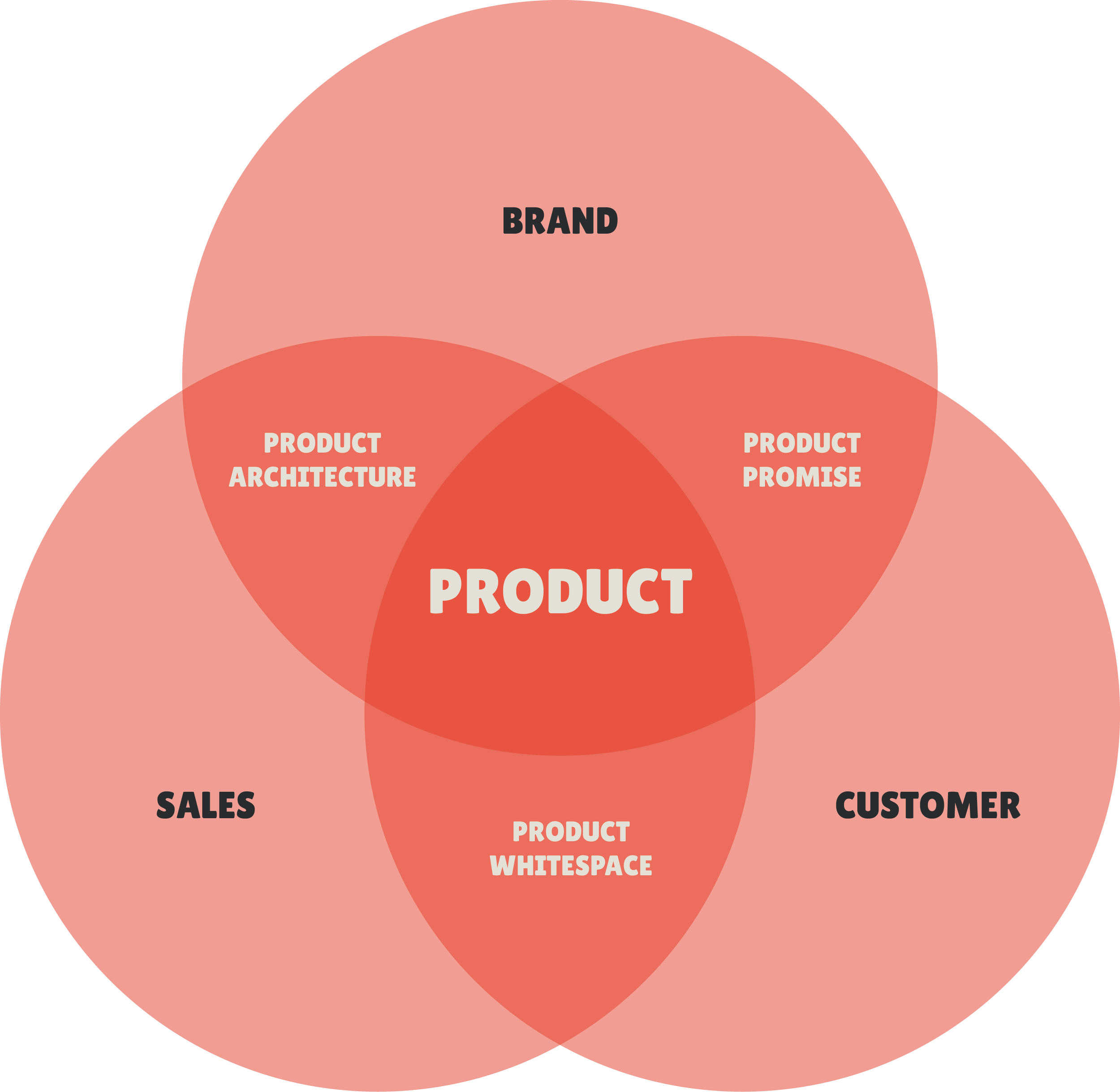
Brand and Sales: The Architecture
The relationship between brand and sales is where architecture lives. Architecture is the structure that determines how a collection comes together, how products relate to one another, and how each piece earns its place within the assortment.
A brand may have a clear point of view, but that vision still needs to translate into a collection that makes sense commercially. What products are we offering? What purpose does each serve? Where do we have opportunities to introduce customers to the brand, and where do we give them a reason to invest further? How do the products work together without competing for the same customer or cannibalizing one another?
Architecture brings intention to these decisions. It considers the customer, the use of the product, the price, the performance, and the role each piece plays within the larger assortment. It creates a structure that supports both the creative vision and the business objectives.
Without architecture, collections can become a collection of individual ideas that happen to sit together. There may be good products, but there isn't necessarily a reason for them to exist alongside one another. When the architecture is clear, the assortment becomes easier to navigate, easier to merchandise, and ultimately easier to sell.
Brand and Customer: The Product Promise
The relationship between brand and customer is where the product promise lives. This is the commitment a brand makes to the person choosing to spend their money on it. It establishes what customers can expect from the product, what the brand will consistently deliver, and why they should come back.
A product promise is more than a marketing statement or a list of functional benefits. It is the defining characteristic that customers come to recognize and trust. It might be an unmistakable fit, a particular material experience, thoughtful functionality, or a combination of details that make a product distinctly yours.
Think about the products that have become iconic to the brands behind them. There is usually something recognizable about them, even before you see the label. Customers know what they are getting, why it works for them, and what makes it worth choosing again. That recognition is built through consistency, not repetition for the sake of repetition.
The product promise becomes a filter for every design and development decision. Does this fabric support what we have promised? Does this silhouette reinforce our identity? Does this detail improve the experience we want our customer to have?
Without it, a brand risks making products that are individually appealing but collectively disconnected. Customers may enjoy a particular purchase, but they have little reason to understand what makes the next one distinctly yours.
Customer and Sales: The Whitespace
The relationship between customer and sales is where whitespace lives. Whitespace is the opportunity for a brand to occupy a distinct position in the market, giving customers a meaningful reason to choose it over the alternatives.
This is not necessarily about creating something entirely new or being different for the sake of being different. It is about understanding what customers need, what the market is currently offering, and where there is an opportunity to serve them in a way that feels more relevant, more intentional, or more meaningful.
When a brand understands its customer and the needs it is uniquely positioned to meet, it can make more confident decisions about where to invest in product. It stops chasing every competitor's latest offering and starts building around the opportunities that align with its own identity.
This distinction matters commercially. When a product has a clear reason to exist and offers something the customer recognizes as valuable, the sale becomes less dependent on discounts, novelty, or constant persuasion. The customer understands why the product belongs in their life and what makes it worth choosing.
Whitespace is where differentiation becomes tangible. It gives the customer a reason to look twice, engage with the brand, and ultimately make a purchase.
What Happens When These Elements Don't Align?
Consider the difference between building a product for transactional sales and building a product for a brand intended to last generations.
A transactional approach often prioritizes the immediate sale. The objective may be to capture demand, respond quickly to a market opportunity, or create something that sells through a particular channel. There is nothing wrong with this approach, but it creates a different set of priorities. Product decisions are often driven by what can sell now, what is easiest to produce, or what will generate the quickest return.
A legacy-minded brand has a different responsibility. It needs to consider not only whether a product will sell today, but whether it reinforces the identity the brand wants to build tomorrow. It is thinking about the relationship between products over time, the trust it establishes with customers, and the value those products continue to hold long after the initial purchase.
These approaches can absolutely coexist, but they require a shared understanding of what the business is building toward. Otherwise, the brand may be investing in one direction while sales are pushing another, and product is left trying to satisfy both without a clear set of priorities.
The result is often a disjointed assortment, inconsistent product decisions, and a customer who struggles to understand what the brand stands for. More importantly, the team spends unnecessary energy revisiting decisions that should have been established much earlier.
This is why alignment matters. It doesn't mean everyone needs to have the same perspective or approach every decision in the same way. It means everyone understands the larger objective and how their individual responsibilities contribute to it.
Product Is the Result, Not the Starting Point
Brand, sales, and customer are not separate conversations that happen at different stages of development. They are interconnected foundations that need to inform the product from the beginning.
Architecture ensures the collection works together. The product promise ensures every piece reinforces the brand's identity and builds trust with the customer. Whitespace ensures there is a meaningful reason for the customer to choose the product in the first place.
When these relationships are clear, product development becomes a much more intentional process. Teams can make decisions with confidence because they understand what they are working toward, what matters most, and how each decision contributes to the bigger picture.
A strong product is not simply one that looks good, performs well, or sells through. It is one that serves the customer, reinforces the brand, and supports the business in building something meaningful over time.
Before asking what we should make next, perhaps the better question is whether we have a shared understanding of what we are trying to build.